Showing posts with label navalbots. Show all posts

Wednesday, March 26, 2014

A Mechanical FISH that Perfectly Mimics The Movement Of Marine Creatures


The Robot Set To Make A Splash! Mechanical FISH Perfectly Mimics The Movement Of Marine Creatures -- Daily Mail

* Robotic fish made of rubber changes direction in a fraction of a second
* Movements are controlled by carbon dioxide from a built-in canister
* Once released, gas passes through a channel, causing the tail to bend
* The fish performs up to 30 manoeuvres before the carbon dioxide runs out
* Its inventor hopes to use it to learn more about the behaviour of fish

Forget clunking, giant humanoid robots, an inventor in the U.S has created a soft machine that is not only waterproof, it perfectly mimics the rapid, elegant movement of a fish.

Andrew Marchese, a graduate student at the Massachusetts Institute of Technology (MIT), created the soft exterior robot to learn more about how fish behave.

MIT said the robotic fish is ‘the first self-contained autonomous soft robot capable of rapid body motion’ and will be featured in their new Soft Robotics journal.

Read more ....

My Comment: Impressive video.

Tuesday, March 20, 2012

Here Comes The U.S. Navy's Robot Jellyfish


Robotic Jellyfish Fuelled By Hydrogen Invented -- BBC

Engineers in the US say they have invented a hydrogen-powered robot that moves through water like a jellyfish.

Development of the robot, nicknamed Robojelly, is in the early stages but researchers hope it could eventually be used in underwater rescue operations.

Writing in Smart Materials and Structures, Yonas Tadesse said the jellyfish's simple swimming action made it an ideal model for a vehicle.

Being fuelled by hydrogen means, in theory, it will not run out of energy.

Mr Tadesse, the lead author of the study, said: "To our knowledge, this is the first successful powering of an underwater robot using external hydrogen as a fuel source."

Read more ....

More News On The US Navy's Development Of The Robot Jellyfish

Just when you thought it was safe to go back in the water: American scientists unleash robotic jellyfish -- Daily Mail
Jellyfish-Inspired Robot Runs on Hydrogen -- Discovery News
Robotic jellyfish may never run out of energy -- MSNBC
Ocean-powered robotic jellyfish could theoretically run forever -- Gizmag
Jellyfish inspires latest ocean-powered robot -- e! Science News
Robot jellyfish fuelled by hydrogen -- Physics World
Robot jellyfish sucks up power from the water -- New Scientist
Robojelly is a robot jellyfish -- UberGizmo
When the Earth is uninhabited, this robotic jellyfish will still be roaming the seas -- io9

Sunday, March 18, 2012

Robotic Subs May One Day Span The Oceans

A mine-hunting robot is lowered from the U.S.S. Avenger into the Strait of Malacca, May 2011. Photo: U.S. Navy

Navy Chief: Robotic Subs Might Span Oceans. (Someday.) -- Danger Room

It’s been the Navy’s dream for years: undersea drones that can swim entire oceans. But it’s been thwarted by science’s inability to build propulsion and fuel systems for a journey of that length. Still, the Navy’s top officer and its mad scientists think that some recent research could help turn the dream into an ocean-crossing reality.

“I’m very much desirous of that end-state, cross-ocean, as feasible,” Adm. Jonathan Greenert, the chief of naval operations, told reporters on Friday. “There are a few propulsion systems that can give you that range — 30-day, 45-day. The fuel needed, regrettably, is extensive, and that drives the size, so we’re not there yet.”

Read more
....

My Comment: This is one of the Navy’s many dream .... undersea drones that can swim entire oceans.

Wednesday, February 22, 2012

Robot Fish


Real Fish Welcome Robotic Overlord Into Their School -- Wired Science

A robotic fish has sailed across an aquatic uncanny valley by tricking real fish into following it upstream.

The feat could lead to better understanding of fish behavior and perhaps some means to divert them from environmental disaster scenes.

“Although some previous works have successfully investigated the interactions between live animals and robots or animal-like replicas, none of these studies have considered robots that are designed to simulate animal locomotion,” wrote the authors of a new study about the robot.

Read more ....

Wednesday, March 31, 2010

Oceanology: Robot 'Gliders' Swim The Undersea World

Engage the wave drive (Image: Liquid Robotics)

From New Scientist:

THE way we study oceans could be transformed by a high-tech "surfboard" that generates its own power from sunlight and water waves. The device is capable of navigating at sea for months at a time and recently completed a 4000-kilometre trip from Hawaii to San Diego, California.

Read more ....

Friday, March 26, 2010

Autonomous Submarinebot Heads Down on Deepest-Ever Undersea Search For Undiscovered Life

Autosub6000 via The Register

From The Popular Science:

While some scientists resort to undersea drilling to find undiscovered forms of life, a new group of researchers has decided that piloting a robotic submarine into a submerged volcano was the way to go. By exploring the deepest, hottest, undersea volcano ever probed, the researchers hope to find clues to both the beginnings of life on Earth, and the possible forms of life on other planets.

Read more ....

Friday, February 26, 2010

Ocean Robot 'Plans Experiments'

From The BBC:

Scientists in the US are using an underwater vehicle that can "plan its own experiments" on the seafloor.


The "Gulper AUV" is programmed to look for the information that scientists want and plan its own route, avoiding hazardous currents and obstacles.

The research team described this advance at the Ocean Sciences meeting in Portland.

The group explained how it could "train" the robot to bring the best science back to the surface.

Read more ....

Tuesday, February 23, 2010

Autonomous Submarine 'Bot Plans Experiments, Navigates Without Human Help

One of MBARIs Automatic Underwater Vehicles Gulper is a high-tech update to this earlier-generation sister research vessel, which was used for seafloor mapping. Monterey Bay Aquarium Research Institute

From Popular Science:

Researchers at the Monterey Bay Aquarium Research Institute are done spending valuable time heading out to sea on routine monitoring missions, and they have the autonomous underwater robot to prove it. A team of marine researchers there has developed what they are calling the Gulper automatic underwater vehicle (AUV) that operates autonomously far out to sea, planning its own experiments and negotiating ocean depths without human input.

Read more ....

Wednesday, February 3, 2010

DARPA's Robotic Ghost Ships Will Stalk Submarines

Robot Frigates Now imagine this ship without the people U.S. Navy/Scott Taylor

From Popular Science:

Ships that appear in perfect working order except for a missing human crew would normally raise suspicions that something has gone terribly wrong, possibly in the vicinity of the Bermuda Triangle. Yet an unmanned frigate is exactly what DARPA's mad scientists at the Pentagon have ordered, according to The Register. The automated ships' mission would have it spending months cruising the seas unmanned, on the hunt for ghostly enemy submarines.

Read more ....

Tuesday, November 10, 2009

Miniature Robots To Swarm The Oceans

This digital image shows how autonomous underwater explorers (AUEs) will be used to provide new information about the oceans. Credit: SIO

From Live Science:

Swarms of soup-can-sized robots will soon plunge into the ocean seeking data on poorly understood phenomena from currents to biology.

With $2.5 million in new funding from the National Science Foundation, researchers at the Scripps Institution of Oceanography will create and deploy fleets of autonomous underwater explorers (AUEs) to explore the depths. Tens or hundreds of pint-sized robots would be deployed along with one the size of a soccer ball, in setups repeated wherever they are needed.

Read more ....

Monday, November 2, 2009

ANIMAL ROBOTS: Marine Machines Made in Nature's Image


From National Geographic:

October 26, 2009--If it looks like a fish and swims like a fish, it could be a robot--such as the University of Bath's Gymnobot (pictured), inspired by an Amazonian knifefish.

Researchers worldwide are developing robots that look and act like aquatic creatures. That's because biomimetic gadgets--bots that take inspiration from nature--are often more efficient than their clunkier counterparts.

Read more ....

Saturday, October 10, 2009

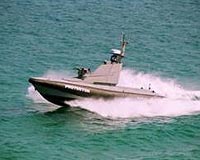
Israeli Navy To Deploy Robot Craft

Photo: The Protector.

From Space Daily:


The Israeli navy will shortly begin deploying unmanned craft along the Mediterranean coast, particularly off the Hamas-held Gaza Strip in the south and Lebanon in the north where Hezbollah guerrillas operate.

These highly maneuverable unmanned surface vehicles, operated by remote control from land stations, can carry out a wide range of missions, such as patrolling coastal waters to counter gun-running and infiltration with less prospect of being detected than the much larger manned vessels.

Read more
....

Thursday, September 3, 2009

Engineering Students Build Underwater 'Bot

Three Long Beach City College ROV Team members transport their vehicle from the pool. On the left is Ricardo Casaine, in the middle is Nathan Grefe, and on the right is Baxter Hutchinson. Credit: Steve Van Meter/VideoRay

From Live Science:

Remotely-operated vehicles, or ROVs, are underwater robots that can go where the environment is too deep or difficult for human divers. I learned how to design and build ROVs as a student in the electrical department at Long Beach City College (LBCC), where every year, students enrolled in the department's robotics class form a team that competes in the Marine Advanced Technology Education (MATE) Center's International Student ROV Competition.

The MATE competition is a pool-based competition that uses props to simulate realistic underwater workplaces. The MATE Center is one of eleven Advanced Technological Education (ATE) Centers established with funding from the National Science Foundation's ATE Program.

Read more ....

Saturday, August 22, 2009

Robotic Fish Could Patrol Waterways

Mechanical engineers Kamal Youcef-Toumi and Pablo Valdivia have designed the sleek robotic fish to more easily maneuver into areas where traditional underwater autonomous vehicles can’t go. Credit: Patrick Gillooly/MIT

From Live Science:

Schools of newly-designed robotic fish could one day patrol waterways, swimming around as fluidly as the real fish they're based on, looking for environmental pollutants and inspecting submerged structures, such as boats and oil pipelines.

Mechanical engineers Kamal Youcef-Toumi and Pablo Valdivia Y Alvarado designed the sleek robotic fish to more easily maneuver into areas where traditional underwater autonomous vehicles can't go.

Read more ....

Sunday, June 28, 2009

Robot Jellyfish Swims Just Like The Real Thing

Jellybot: Sung-Weon Yeom and Il-Kwon Oh

From Popsci.com:

Even though a jellyfish is 90 percent water, it moves at about 40 mph. Jellyfish use their bell -- the top portion, above the tentacles -- to create a jet that propels them through water. Now, scientists at the Chonnam National University in the Republic of Korea have built a robot that mimics the movement. The robot, using an electro-active polymer artificial muscle, retracts and expands its skirt, exerting a minimal voltage and propelling the jellybot faster than you can swim.

Read more ....

Saturday, May 23, 2009

Rutgers Attempts Robot Atlantic Crossing

From Slashdot:

"Rutgers University students and staff launched a Slocum glider AUV in an attempt to be the first such vehicle to cross the Atlantic Ocean. Progress so far is good, but it will be a long 6- to 9-month journey. Status as well as other information can be tracked here. Media links can be found in the lower left section of page, among images, and storyline blogs."

And Google Earth fans can track the vehicle's progress, too.

Read more ....

Friday, April 24, 2009

Robot Sailing Boat Can Reach Any Given Destination Completely Autonomously

The sail is a lot heavier than one might think. An unusually thick material was used to enable it to withstand the Caribbean storms. (Credit: Image courtesy of SSA/ETH Zurich)

From Science Daily:

ScienceDaily (Apr. 19, 2009) — Mechanical engineering students from ETH Zurich have developed an unmanned sailing boat in a focus project that can reach any given destination completely autonomously. The Avalon robot sailing boat is due to set sail from Ireland in the fall and head for the Caribbean.

The Caribbean is still a long way off. But at least Avalon has already had a taste of the water on Lake Zurich. Admittedly, the first run ended on a sandbank, but that – and everyone agrees – can happen to any sailor. And Avalon has a good excuse: the software program that really enables it to sail by itself is still very much in its infancy. However, the “Students Sail Autonomously” team (SSA) is confident that they can overcome the teething problems.

Read more ....